





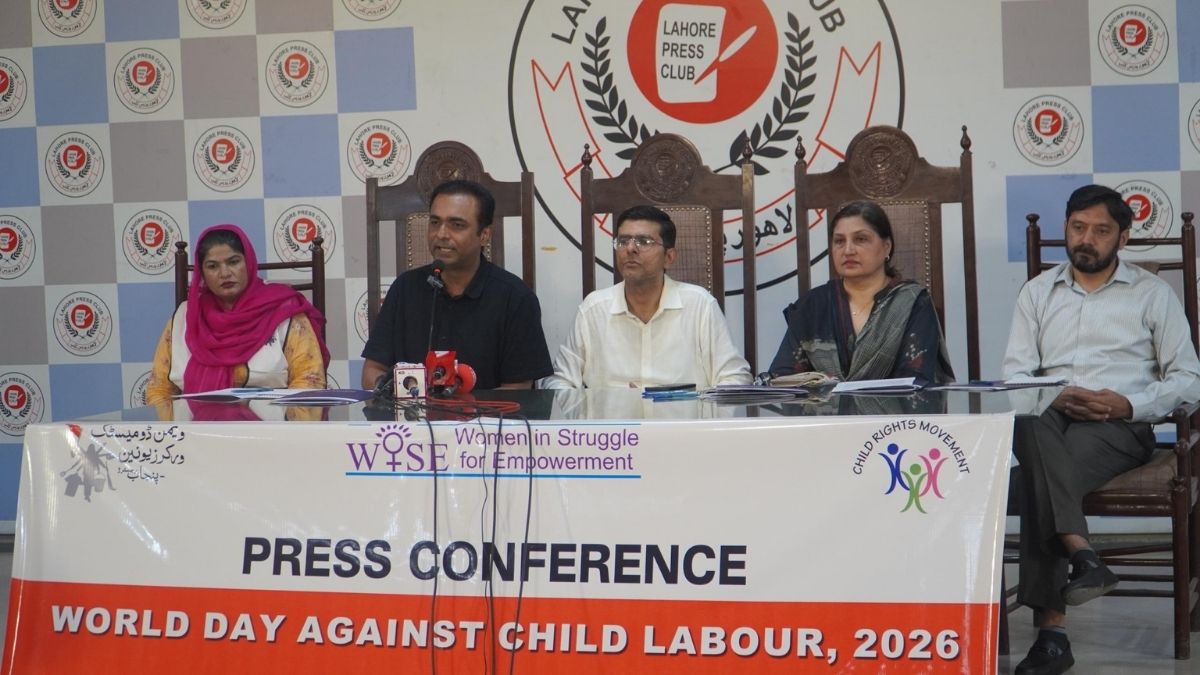
Lahore, 12 June 2026: Civil society organizations working on child rights, labour rights, and domestic workers’ rights have called for strengthened efforts to address child labour in Punjab, noting that millions of children continue to be engaged in labour despite existing legal protections and policy commitments.
The call was made during a press conference organized at the Lahore Press Club by Women in Struggle for Empowerment (WISE), the Child Rights Movement (CRM), and the Women Domestic Workers Union Punjab on the occasion of World Day Against Child Labour.
Speakers highlighted findings from the Punjab Child Labour Survey (PCLS) 2019–20, which estimated that 6.04 million children aged 5 to 17 years are engaged in child labour across Punjab. Of these, around 3.3 million children work in agriculture, while more than 800,000 are engaged in manufacturing-related activities. The survey further indicates that boys account for a significantly higher proportion of children engaged in labour than girls.
Speakers highlighted that child labour remains concentrated in informal and difficult-to-regulate sectors, including agriculture, domestic work, brick kilns, workshops, and small-scale manufacturing. They expressed particular concern over the continued presence of children at brick kilns, where debt bondage continues to trap families in cycles of exploitation despite the prohibition of bonded labour under Pakistani law.
Speakers also drew attention to the vulnerability of child domestic workers. Referring to media monitoring conducted by Women in Struggle for Empowerment (WISE) between January 2019 and June 2026, they reported 208 cases involving domestic workers, including deaths, injuries, sexual violence, and other forms of abuse. Girls accounted for 86 per cent of the reported victims. While most cases were reported to the authorities, speakers expressed concern over the low rate of legal resolution, highlighting continuing challenges in accountability and access to justice.
Speakers emphasized that the employment of children in domestic work remains prohibited under the Punjab Domestic Workers Act 2019, which bars the employment of children under the age of 15 years in households. However, weak enforcement, limited registration of workers, lack of written contracts, and low public awareness continue to undermine effective implementation of the law.
Civil society organizations welcomed the enactment of the Punjab Labour Code 2026 as a significant legislative development and noted its potential contribution to strengthening protections against child labour. They highlighted that the Code defines a child as any person below the age of 16 years, aligning labour legislation with Article 25-A of the Constitution of Pakistan, which guarantees free and compulsory education for all children between the ages of five and sixteen. The organizations also urged the Government of Punjab to notify the commencement of the Punjab Labour Code 2026 without delay and undertake the necessary administrative and institutional measures required for its effective implementation.
Civil society organizations noted that Pakistan has developed an extensive legal and policy framework addressing child labour, bonded labour, education, and child protection. However, implementation challenges, weak labour inspection systems, limited social protection coverage, and persistent economic vulnerabilities continue to place children at risk of labour and exploitation.
The organizations called for stronger enforcement of child labour laws, improved labour inspections, expanded social protection measures, universal access to quality education, and evidence-based child labour eradication strategies informed by provincial child labour surveys. They also emphasized the importance of strengthened coordination among relevant government departments and stakeholders to accelerate progress towards the elimination of child labour.
The press conference concluded with a call for coordinated action by government institutions, employers, civil society organizations, trade unions, and communities to ensure that children are protected from economic exploitation and are able to access education, protection, and opportunities for healthy development. The organizations also emphasized the importance of accelerating progress towards Sustainable Development Goal Target 8.7, which commits countries to ending child labour, forced labour, modern slavery, and human trafficking, and called for sustained political commitment to achieving these objectives.

